Renueva tu Pavimento Español
Renueva tu Pavimento

Restoring tired stamped concrete, concrete and block paving in the province of Málaga

In shortRenueva tu Pavimento restores outdoor surfaces that are structurally sound but look worn: stamped (imprinted) concrete, plain concrete and block paving on driveways, patios, terraces and carports. The work follows a fixed sequence – pressure washing, filling cracks and holes, masking edges, two coats of tinted acrylic resin and an optional protective top coat. It does not cure a sunken base. Send us a photo and the approximate m² – free, no-obligation quote.

Send us a photo and the approximate m² – free, no-obligation quote

Stamped concrete driveway restored with a dark grey coating after crack repair
A stamped concrete driveway after crack repair and a dark grey coating

What does restoring a paved surface mean, and when is it the right choice?

Restoring means keeping the existing surface and renewing its face: we clean it, repair the small defects, and apply a tinted coating so the colour is even again. It is the right choice when the slab or the pavers are still firm and level, and the problem is how they look rather than how they behave under a car or underfoot.

Many villas and townhouses along the Costa del Sol have driveways and terraces in stamped concrete that were laid years ago with a strong colour and a glossy finish. Sun, rain, garden water, leaf litter and car tyres gradually take that finish away. What remains is a patchy, chalky surface with hairline cracks, dark stains under the cars and a pattern that no longer reads clearly. Replacing the whole thing is disruptive and generates rubble; restoration keeps everything in place.

The decision comes down to one question: is the problem on the surface or underneath it? If the paving has dropped, rocks, holds puddles in new places or has lifted over a tree root, the base has moved and no coating will put that right. In those cases the honest answer is a structural repair first, which our sister site Adoquines Hundidos covers in detail. If the surface is merely faded, stained and lightly cracked, restoration is usually the sensible route.

Is it sinking, only faded, or broken beyond use? The answer decides between base repair, restoration and replacementSinking or moving?Repair the baseOnly colour or wear?Restore without replacingBroken or obsolete?Replace the paving
Is it sinking, only faded, or broken beyond use? The answer decides between base repair, restoration and replacement

Which surfaces can be restored without replacing them?

We work on three families of outdoor paving: stamped or imprinted concrete, plain or brushed concrete, and concrete block paving. Each one takes the coating slightly differently, so the preparation changes, but the logic of the job is the same: a clean, sound, dry surface, defects filled, edges protected, then colour.

  • Stamped concrete driveways, paths and pool-side areas whose colour has washed out or whose original sealer has failed – see stamped concrete restoration.
  • Plain concrete yards, ramps, carports and garage aprons that look grey, stained or uneven in tone – see concrete painting.
  • Block paving that has bleached in the sun or is marked with oil, moss and black lichen spots – see paver painting.
  • Hairline and settlement cracks, chipped edges and small holes that need filling before any coating – see crack repair.
  • Surfaces that only need a deep clean and an optional protective coat – see cleaning and sealing.

Two kinds of space come up again and again in enquiries from owners: the driveway, with its car traffic and tyre marks, and the patio or terrace, where furniture, plant pots and pool water leave their own marks. We describe both in separate pages on driveway restoration and patio and terrace restoration, because the priorities differ.

How does the restoration process work, step by step?

Every job follows the same order, because each step prepares the next one. Skipping or rushing the preparation is the most common reason a painted driveway starts peeling, so most of the visible effort goes into the stages before any colour is applied.

Pressure washing, crack repair, masking, two coats of tinted resin and an optional protective coat1Pressurewashing2Crackfilling3Edge masking4Tinted resin(2 coats)5Protectivecoat
Pressure washing, crack repair, masking, two coats of tinted resin and an optional protective coat
  1. Pressure washing of the whole area to remove dirt, loose material, organic growth and the remains of old, failing sealer.
  2. Surface repair: cracks and holes are filled with acrylic filler or repair mortar and smoothed with a spatula.
  3. Masking: brick edgings, walls, door thresholds, pillars and planters are protected with masking tape.
  4. Tinted acrylic resin applied in two coats, by long-handled roller on open areas and by brush along walls and posts.
  5. Optional final protective coat over the colour.
  6. Final clean-up and removal of tapes.

The detail of each stage, with photos from a real driveway, is in our guide to restoration step by step. If you want to understand why the cleaning and drying matter so much, the guide to surface preparation explains what we look for before we open a tin.

What does a restored stamped concrete driveway look like?

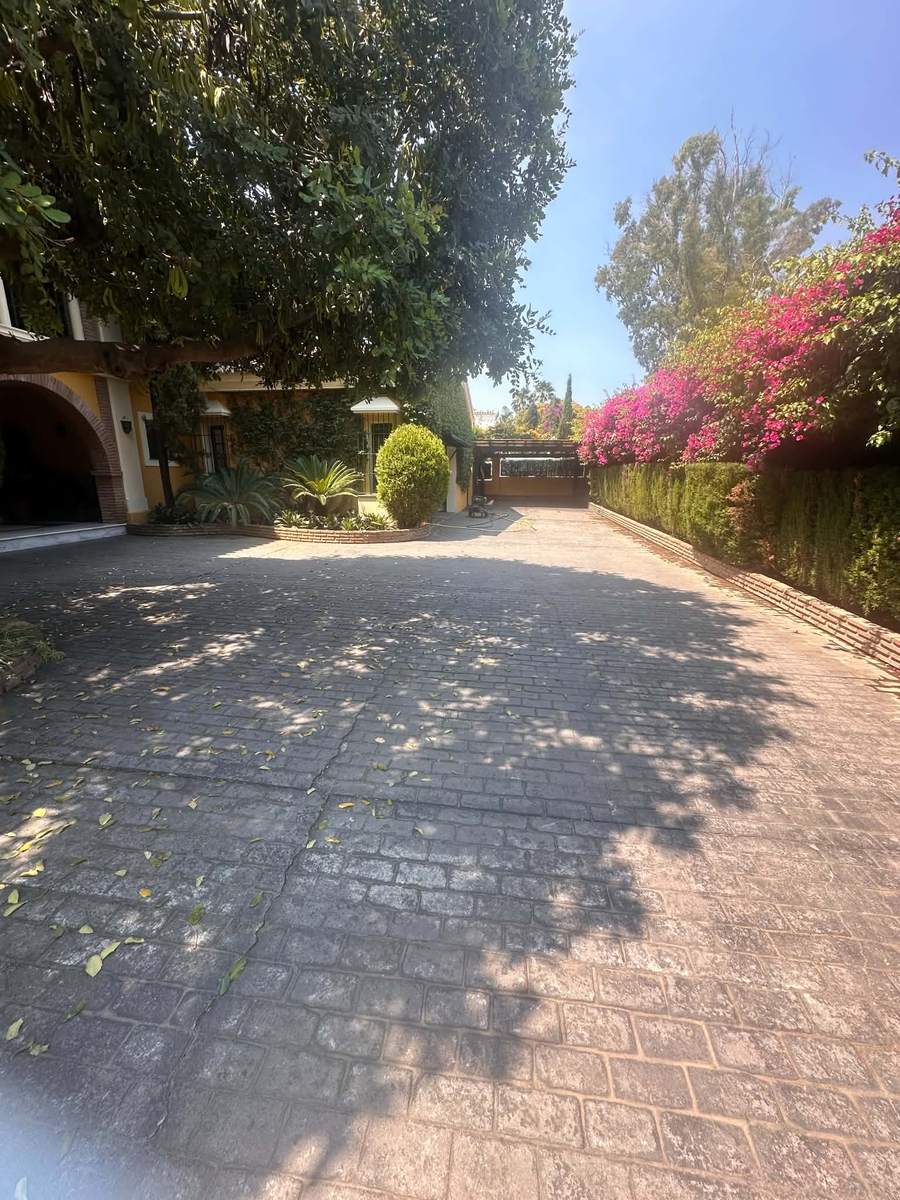
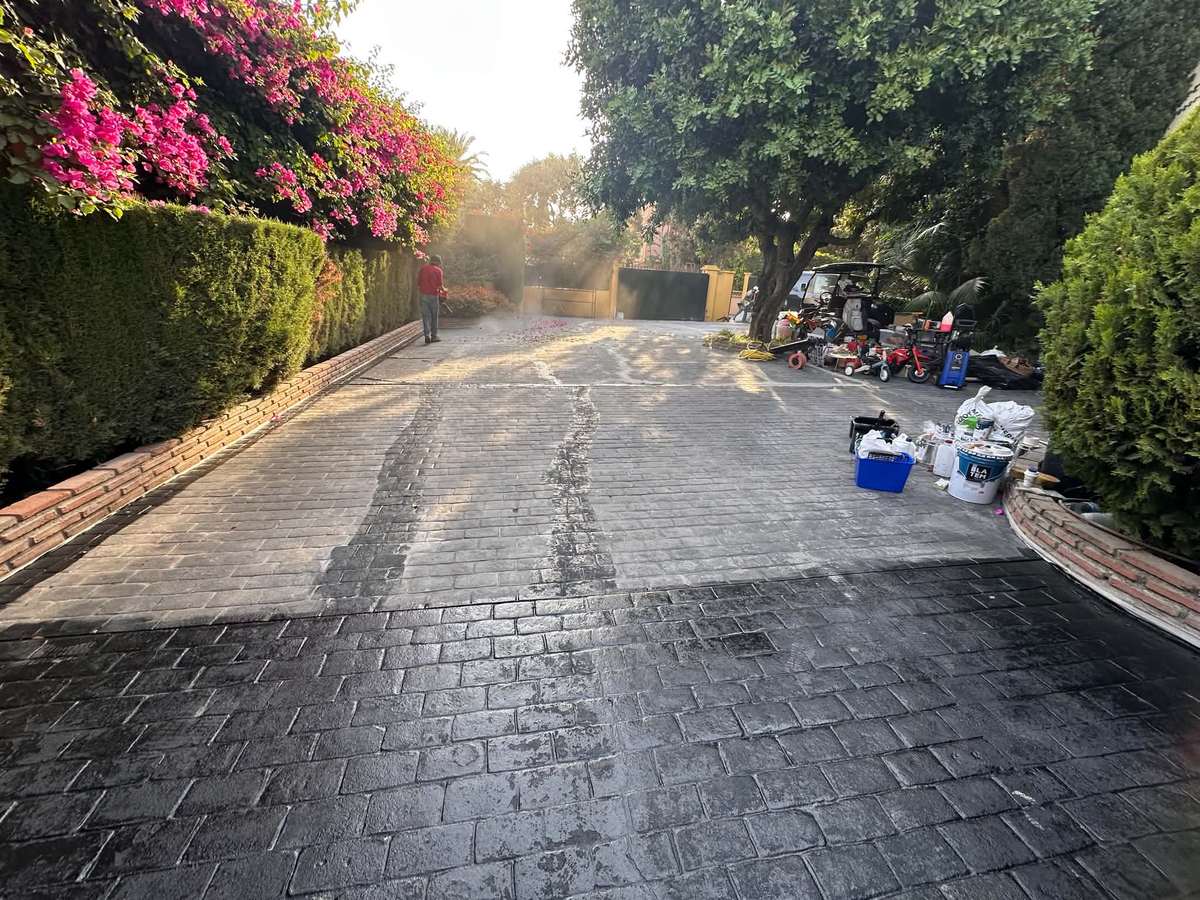
The clearest way to judge restoration is to compare the same surface before and after. The photo set on our projects page follows a long stamped concrete driveway with a cobble pattern, from a faded, worn and leaf-strewn surface through crack filling and masking to a uniform dark grey coating with a glossy look.

The same job included a covered parking area under a reed-roofed pergola and a garage with its apron, which were washed, repaired and coated in the same dark grey. Seeing the garage before and after side by side shows how much of the original impression of age comes from colour loss rather than real damage. You can follow every stage on the restoration projects page and browse the full photo gallery.

Why does stamped concrete go white, chalky or blotchy?

Whitening usually has one of two origins: salts carried to the surface by moisture, which dry as a white bloom, or an old sealer that has broken down and turned milky or powdery. Both look similar from a distance, and both need to be dealt with before recolouring, otherwise the new coat sits on a weak layer.

Flaking and surface whiteness are not the same as a structural fault. A slab can look tired and still be perfectly sound. Before quoting we ask for close-up photos of the white areas, because the cause changes the preparation. Our guide on white haze and stains explains efflorescence, sealer blush and the difference between them in plain terms, and the article why stamped concrete turns white or loses colour looks at the typical situations on driveways.

Should you patch, resurface or replace?

Patch when the damage is local, resurface or recoat when the whole area is sound but tired, and replace when the surface is broken up, crumbling or the base has failed over a wide area. Most of the driveways and terraces we are asked about fall into the middle group.

SituationSensible approachWhere to look
Faded colour, stains, hairline cracks, firm and level surfaceRestoration: clean, fill, two coats of tinted resin, optional protective coatThis site
Sunken or rocking areas, new puddles, tyre rutsLift, correct the base and relay before any finishingSubsidence diagnosis
Broken, crumbling or obsolete paving over most of the areaRemove and lay new pavingPaving replacement

Our guide restore without replacing goes through the warning signs that rule restoration out, and resin, paint or replace compares the options side by side. If you are weighing up the cost of each route, the price discussion lives on our sister site, for example the page on restoration cost.

Can you paint the whole drive in a new colour?

Yes – a tinted coating can either bring back something close to the original tone or move the whole surface to a different colour, as in the dark grey driveway shown on this site. What it does not do is recreate the multi-tone shading that some stamped concrete had when new; the result is a more even, single colour over the pattern.

Choosing a colour is worth some thought. Dark tones hide tyre marks and stains well and give a crisp, modern look against white walls; lighter tones stay closer to the traditional terracotta and sand shades of Andalusian houses. We are happy to discuss options from photos, and the decision about painting the whole drive or only part of it is yours. Where a surface has very different areas, such as a driveway and a covered parking bay, treating them all in one colour gives a unified look.

Kerb appeal is often the real reason behind an enquiry. The driveway is the first thing a visitor, a holiday tenant or a prospective buyer sees, and a washed-out, stained entrance makes an otherwise well-kept villa look neglected. Restoring the colour of the drive, the garage apron and the path to the front door changes that first impression without the noise, dust and skips of a full replacement.

How do you look after the surface once it has been restored?

Maintenance after restoration is simple but it matters: regular sweeping, prompt cleaning of oil and garden soil, gentle washing rather than aggressive pressure close to the surface, and keeping an eye on any new crack. The optional protective top coat is part of looking after the colour, and it can be renewed later when the surface starts to look dull.

Recovering and maintaining the brightness and colour of an outdoor surface is an ongoing task rather than a one-off event. Our guide to aftercare after restoration lists what to do, what to avoid and when to call us back, and the article on what to know before painting outdoor paving covers the questions owners usually ask before committing.

Who do we work for, and how do we keep you informed?

Most of our enquiries come from private owners of villas and townhouses, many of whom live abroad for part of the year, from communities of owners with shared driveways and parking areas, and from small businesses with tired forecourts. Communication is in English or Spanish, whichever you prefer, and photo updates from site are normal practice when you cannot be there in person.

If the paving belongs to a community of owners, work on common areas needs a resolution of the owners' meeting under the Horizontal Property Law (Ley 49/1960); the community administrator can tell you which majority a given job requires. Whether a town hall wants any paperwork for recoating an existing private surface depends on its own ordinance, so it is worth a quick check with the municipality before work starts.

This site is one of six websites run by the same self-employed contractor, Bauman Raymond Attila, based in Marbella and covering the whole province of Málaga. Each site focuses on one type of job. We work with Mapei products, and we execute the work: we do not draft building projects, apply for permits on your behalf or carry out geotechnical studies.

What affects the cost of restoring a paved area?

The main cost factors are the area in square metres, the state of the surface, how much crack and hole repair is needed, access for equipment and water, the amount of edging to mask, and whether you want the optional protective coat. We do not publish figures on this site; published prices, a sample quote and a calculator are on our sister site.

For an indication, see restoration cost or the paving cost calculator, and the articles what drives the price of restoring stamped concrete and restore or replace: myths about cost. For an actual figure for your surface, send us a photo and the approximate m² – free, no-obligation quote.
How we work

Pressure washing1Pressurewashing2Crackfilling3Edge masking4Tinted resin(2 coats)5Protectivecoat

Work and photographs

Stamped concrete driveway with a cobble pattern, faded and worn before restoration
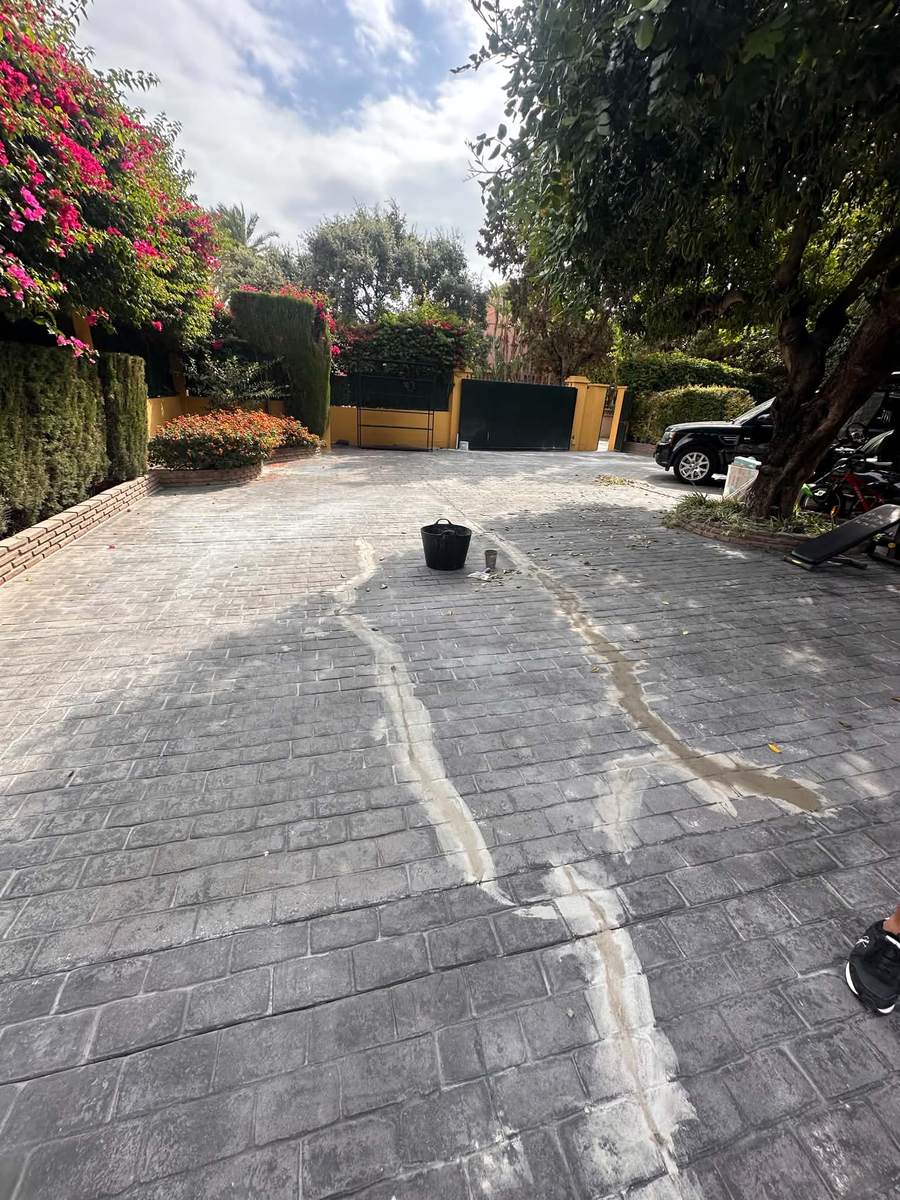
Cracks in a stamped concrete driveway filled with repair mortar
Stamped concrete driveway half painted: front section coated dark grey, back section with repaired cracks

Projects · Gallery

Areas we cover

Paving restoration in AlgarroboWorn driveways, yards and patios in Algarrobo refreshed in place, without lifting the existing surface.Restoration in BenalmádenaShared community paving and private drives in Benalmádena refreshed without lifting them.Restoration in CasaresConcrete and pavers in Casares Costa, Secadero and the village renewed in place.Restoration in EsteponaDrives and terraces in Estepona's urbanizaciones restored with remote approval and photo updates.Restoration in FuengirolaForecourts, garage aprons and patios in Fuengirola renewed with neat edges and repaired cracks.Restoration in ManilvaTerraces, patios and drives in Sabinillas, Duquesa and Alcorrín renewed without digging up.Restoration in MarbellaVilla drives, carports and patios across Marbella renewed in stamped concrete, concrete or pavers.Restoration in MijasPavers, stamped concrete and patios in Mijas Pueblo, Mijas Costa and the golf areas renewed in place.Restoration in Málaga cityPatios, terraces and drives in every Málaga district renewed without lifting the existing surface.Restoration in NerjaTerraces, patios and drives in Nerja and Maro restored in place, timed around your guests.Restoration in Rincón de la VictoriaBlock paving and concrete in Añoreta, Benagalbón and La Cala del Moral renewed without relaying.Restoration in TorremolinosCommunity paths, entrances and private terraces in Torremolinos renewed without lifting.Restoration in TorroxCracks and faded concrete in Torrox Costa, El Morche and Torrox Park repaired and recoated.Restoration in Vélez-MálagaYards, drives and patios in Torre del Mar, Lagos, Cajiz, Triana and other núcleos renewed in place.Restoration in BenahavísVilla drives and courtyards in La Quinta, Daidín, Los Arqueros and other estates renewed in place.Restoration in Alhaurín de la TorreBlock paving and concrete in Zapata, El Romeral and Pinos de Alhaurín renewed area by area.Restoration in CoínPressure washing or full restoration for drives, yards and patios in Coín and its surroundings.Restoration in CártamaDrives and patios in Cártama restored in place, with a quote that lists every stage.Restoration in OjénDrives, terraces and patios in Ojén, La Mairena, El Vicario and Palo Alto renewed in place.Restoration in Alhaurín el GrandePavers, patios and drives in Alhaurín el Grande and Alhaurín Golf renewed, with aftercare advice.

See all

Guides and articles

When restoration works and when it does notA practical test for owners: which tired surfaces can be renewed in place, and which need base repair or replacement.Restoration step by step, with site photosFollow a real stamped concrete driveway from worn and faded to a uniform dark grey finish, stage by stage.White haze, efflorescence and fadingHow to tell salt deposits, cloudy sealer and true colour loss apart, and what each means for restoration.Resin, paint or replace?A side-by-side look at the three routes for tired outdoor paving, with the questions that decide between them.Surface preparation, explainedWhy the hidden work before coating matters most, and what each preparation step involves on a real driveway.Aftercare after restorationEveryday care, stain handling and the signs that tell you a restored surface is ready for a recoat.What drives restoration costThe real factors behind a stamped concrete restoration quote, explained without the sales talk.Restore or replace: cost mythsSix common assumptions about paving costs, and what actually decides between restoration and replacement.Paint block paving or replace it?How to judge whether faded pavers can be renewed in place, and the signs that they need relaying.Why stamped concrete goes whiteFour common reasons a stamped concrete driveway turns pale or patchy, and how to tell them apart at home.Resin, paint or a new pour?A scenario-based comparison of the three options for tired stamped concrete around a villa.Coat plain concrete or go decorative?What a tinted coating can and cannot do for a plain concrete slab, compared with laying new stamped concrete.How a driveway restoration runsThe working process from first contact to handover, and the questions owners usually ask along the way.Before you paint outdoor pavingThe practical questions owners ask before a driveway, patio or terrace is coated, with straight answers.When restoration is not enoughThe warning signs that a driveway or patio needs base repair before any new colour is applied.Owner's checklist for paving restorationThe questions to ask, the answers to expect and the warning signs, before you hire anyone to restore your paving.

Frequently asked questions

Can stamped concrete be restored instead of replaced?

Yes, as long as the slab is firm and level. Restoration cleans the surface, fills cracks and holes, protects the edges and applies two coats of tinted acrylic resin, with an optional protective top coat. If the concrete has sunk or broken up, the base must be dealt with first.

Does restoration fix paving that has sunk?

No. A coating changes the appearance of the surface, not the level of the ground underneath. Sunken, rocking or rutted areas need the pavers lifted and the base corrected, which is the work of our sister site for sunken paving repair. Restoration can follow once the surface is level again.

What types of surface do you restore?

Stamped or imprinted concrete, plain or brushed concrete and concrete block paving, on driveways, garage aprons, carports, paths, patios, terraces and pool areas. We also pour new stamped concrete and lay asphalt. Timber decking and natural stone slabs are not restored on this site.

Why is my stamped concrete going white?

The most common causes are salts brought to the surface by moisture, which dry as a white bloom, and an old sealer that has broken down and turned milky. Close-up photos help us tell them apart, because each needs different preparation before any new coating is applied.

Can I choose a different colour from the original?

Yes. The tinted resin can bring the surface back to a tone close to the original or change it completely, for example to the dark grey seen on our project photos. The result is a uniform colour over the existing pattern rather than the multi-tone effect of new stamped concrete.

What products do you use?

We work with Mapei products. For each job we choose the system according to the surface and its condition, and we describe it in the quote. We prefer not to publish technical claims about products on the website, so ask us directly if you want details for your case.

How do you prepare the surface before coating?

Preparation is pressure washing of the whole area, filling cracks and holes with acrylic filler or repair mortar, and masking brick edgings, walls, thresholds and posts with tape. The surface must be clean, sound and dry before the first coat of tinted resin goes on.

Do you fill the cracks before painting?

Yes, every visible crack and hole is filled before the coating. On the driveway shown on our projects page, the filled cracks appear as light grey lines before painting and disappear under the dark grey coat. Wide or moving cracks may point to a base problem, which we will tell you about.

Is the protective top coat necessary?

It is optional. It is applied over the two coats of tinted resin as an extra layer, and many owners choose it for driveways with car traffic. We explain the choice in the quote so you can decide based on how the surface is used.

Can you restore block paving as well as concrete?

Yes. Faded or stained concrete block paving can be cleaned and recoloured with tinted resin. Where joints have been washed out they need refilling before any coating, and blocks that move or have sunk point to a base issue that should be repaired first.

Will pressure washing remove black lichen spots?

Pressure washing removes most dirt and organic growth, but black lichen spots can leave marks that do not fully disappear with water alone. When a surface is going to be recoated afterwards, the tinted resin covers the remaining shadow, which is one reason owners choose restoration over cleaning only.

Do I need to be in Spain while the work is done?

No. Many of our clients live abroad for part of the year. We agree the scope and colour by email or WhatsApp, arrange access with you, a neighbour or a property manager, and send photo updates from site so you can follow the work remotely.

Do you work for communities of owners?

Yes, for shared driveways, parking areas and paths. Under the Horizontal Property Law, work on common elements needs a resolution of the owners' meeting, and your community administrator knows which majority applies. We can provide a quote for the meeting.

Do I need permission from the town hall to recoat my driveway?

It depends on the municipality. Each town hall's ordinance decides which procedure, if any, applies to a given job, so along the coast the simplest step is to ask the local planning department about your case. If work touches the public pavement or a vehicle crossing, separate municipal authorisation is needed.

Which areas do you cover?

The whole province of Málaga, from Manilva and Casares in the west through Estepona, Marbella, Mijas, Fuengirola, Benalmádena and Málaga city to Nerja and the Axarquía in the east, as well as inland towns such as Coín, Cártama and Alhaurín.

How much does it cost to restore stamped concrete?

This site does not publish prices. Cost depends on area, condition, crack repair, access and whether you add the protective coat. Indicative prices and a sample quote are on our sister site precioadoquinado.eu, and we give a written quote from your photos and measurements.

How do I get a quote?

Send us a photo and the approximate m² – free, no-obligation quote. Wide shots of the whole area plus close-ups of cracks, stains and white patches help us judge the preparation needed. If something in the photos suggests a base problem, we will say so before quoting.
Can a painted driveway peel?

Coatings fail mainly when they go on over dirt, old loose sealer, moisture or unrepaired cracks. That is why most of the work goes into washing, repairing and drying the surface first. We will not coat over a surface we believe is not ready, and we explain why.

Who is behind Renueva tu Pavimento?

Bauman Raymond Attila, a self-employed contractor based on Avenida Antonio Belón in Marbella. He runs six websites, each focused on one kind of paving job, from new block paving and sunken paving repair to driveways, terraces, restoration and prices.

What is not included in restoration work?

Restoration does not include lifting and relaying pavers, rebuilding the base, laying new paving, drainage works or building projects and permits. Those jobs are covered by our sister sites or, for projects and licences, by architects and technical professionals.

Get a quote

Send us a photo and the approximate m² – free, no-obligation quote

Problem (tick one or more) *
WhatsApp
WhatsApp